Sage Carter · 13 October 2026
Decoding Retention Patterns in Digital Gathering Places After Major System Updates
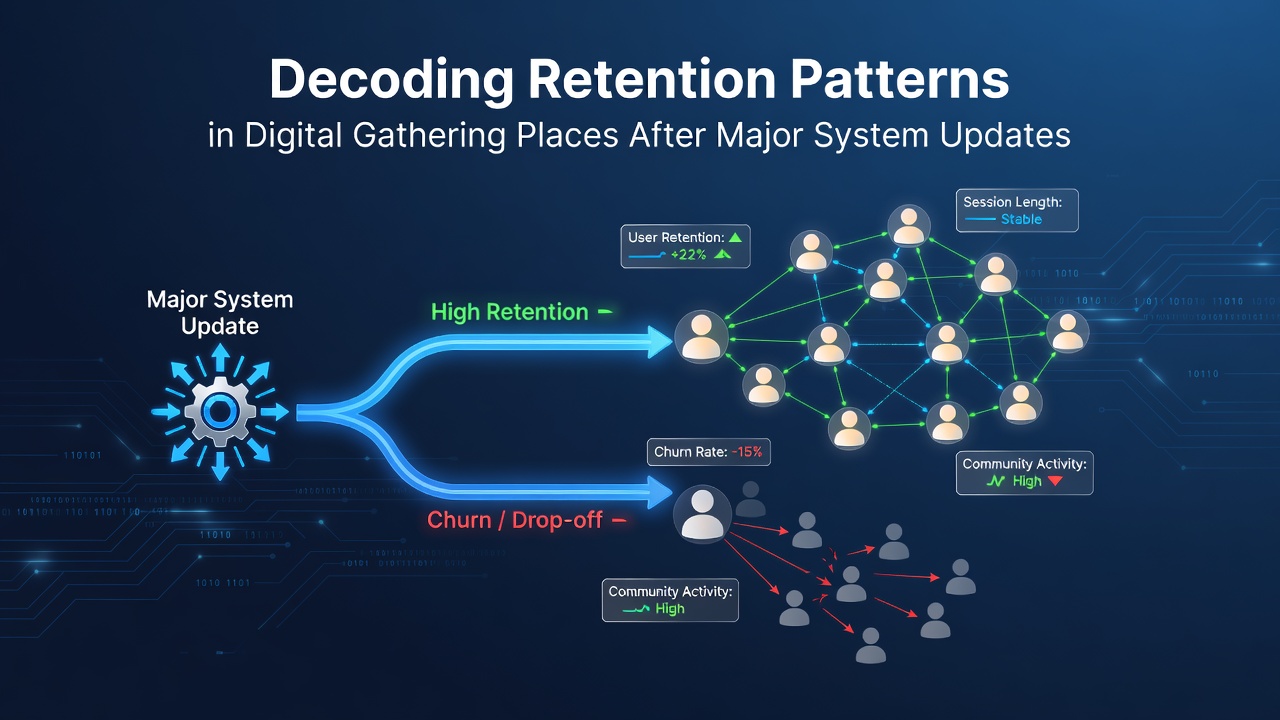
Digital gathering places such as forums, social networks, and collaborative platforms experience distinct shifts in user retention once major system updates roll out, and researchers track these changes through metrics like daily active users, session duration, and return visit rates. Data from platform analytics shows initial activity often declines as members adjust to revised interfaces or backend processes, yet recovery trajectories vary based on update scope and community size. Observers note that seamless transitions tend to preserve core user bases while abrupt alterations accelerate churn in smaller niches.
Observed Patterns Across Platforms
Studies of retention following infrastructure migrations reveal a consistent sequence where engagement dips within the first two weeks post-update, then either rebounds or plateaus depending on feature adoption rates. Those who've analyzed logs from large-scale communities report that users who encounter familiar navigation paths maintain higher loyalty, whereas feature removals prompt quicker exits. In October 2026 several major platforms introduced coordinated backend revisions that altered notification systems and content ranking algorithms simultaneously, and figures from those periods indicate retention stabilized faster in groups with active moderation teams compared to loosely governed spaces.
What's interesting emerges when data segments by user tenure: long-term members demonstrate greater tolerance for temporary disruptions yet still reduce participation if performance lags persist beyond thirty days. Newer arrivals, by contrast, show steeper drop-offs when onboarding flows change without clear guidance. Researchers at academic institutions have mapped these behaviors through cohort analysis, confirming that update frequency itself correlates with baseline retention levels before any single change occurs.
Factors Shaping Post-Update Retention
Multiple variables influence whether communities retain members after system revisions, including the presence of rollback options, communication from administrators, and compatibility with third-party tools. Evidence from industry reports suggests that platforms providing detailed changelogs and preview periods experience slower initial attrition because users anticipate adjustments in advance. Performance metrics collected during the October 2026 wave highlighted how latency reductions in one region boosted cross-border participation while slower regions saw localized exits.
Community type also plays a role. Professional networks focused on knowledge exchange retain users more effectively when updates emphasize search and archival functions, whereas recreational spaces suffer when social discovery tools receive lower priority. A Pew Research Center analysis of digital participation trends documented similar divergences across North American and European samples, noting that regional differences in device usage further modulate outcomes.
Measurement Approaches and Data Sources
Analysts decode retention patterns through a combination of quantitative telemetry and qualitative surveys that capture user sentiment at multiple intervals after an update. Retention curves plotted over ninety-day windows reveal inflection points where churn accelerates or decelerates, and these curves become sharper when updates coincide with external events such as regulatory announcements. Canadian statistical agencies have compiled aggregate data on digital service usage that aligns with these observations, showing seasonal variations in platform stickiness that compound update effects.

Survey instruments distributed within affected communities often surface themes around perceived stability and feature utility, allowing researchers to correlate self-reported satisfaction with behavioral logs. Those who've examined these datasets find that communities maintaining transparent update roadmaps achieve higher re-engagement rates, particularly when administrators address reported bugs within the first week. Geographic variation appears here as well, with Asia-Pacific platforms demonstrating quicker adaptation cycles than counterparts in other regions according to cross-border comparative studies.
Case Examples from Recent Updates
One documented instance involved a collaborative workspace platform that revised its permission hierarchy in mid-2026, resulting in a measurable redistribution of activity toward subgroups that adapted quickly while peripheral members reduced logins. Another example from a hobbyist network showed that integration of new moderation tooling preserved retention among active posters even as casual visitors departed. Data compiled by research consortia indicates these outcomes track closely with the degree of user involvement in pre-launch testing phases.
October 2026 updates across several European-hosted services further illustrated how compliance-driven changes to data handling protocols affected trust signals and subsequent return rates. Observers tracking these events recorded that platforms issuing proactive user notifications retained higher percentages of their pre-update bases compared to those relying on in-app discovery alone. Such patterns underscore the interplay between technical execution and community management practices.
Conclusion
Retention patterns in digital gathering places after major system updates follow predictable sequences shaped by update characteristics, user demographics, and administrative responses. Metrics gathered through October 2026 and prior periods demonstrate that preparation and communication reduce attrition while abrupt shifts amplify it. Continued monitoring across diverse platforms will refine understanding of these dynamics as new infrastructure changes emerge.